Hoid
The Way of KingsHoid, most often encountered under the name Wit or the King’s Wit, occupies an exceptional place in the story’s social and narrative order. He is attached to the royal court yet does not belong comfortably to either the lighteyes or darkeyes hierarchy; he carries a sword without treating it as a military weapon, speaks through mockery, and repeatedly turns apparently casual encounters into warnings or moral tests. His decisive significance lies in this mobility: Hoid can enter scenes of war, ceremony, conversation, and spiritual crisis while remaining difficult to classify, and his presence makes the boundaries of identity and knowledge feel unstable.
Identity and Introduction
Hoid first appears as a rider hurrying from the warcamps to catch up with a hunting party. Adolin Kholin recognizes him before he can be mistaken for a messenger and calls out to him as Wit. Hoid is tall and thin, rides a black gelding, and wears a stiff black coat with black trousers. His deep onyx hair and blue eyes give him a strikingly controlled appearance, while the long, thin sword at his waist suggests more symbolism than practical warfare. As Adolin understands it, the blade is a dueling foil, and Hoid has never drawn it.
His position is socially anomalous. Although Hoid has blue eyes, Adolin does not regard him as truly a lighteyes, but neither is he a darkeyes. The title King’s Wit functions as a category of its own, granting him access to people and spaces that ordinary rank would not explain. He can ride directly toward rulers and highprinces, interrupt serious exchanges, and address powerful men through insult without being treated simply as a soldier, servant, or court official.
Hoid’s appearance at the royal gathering reinforces this mixture of ceremony and irreverence. He moves through the attendants holding a cup of wine, with a silver sword belted at his side, and intervenes when Torol Sadeas continues provoking Dalinar Kholin. His interruption turns Sadeas’s own phrase against him, reducing the highprince’s assertion of authority to material for a joke. Elhokar Kholin’s startled question about when Hoid arrived further presents him as someone who appears at the edge of events rather than being fully accounted for within them.
Wit, Performance, and Warning
Hoid’s customary weapon is language. His humor is quick, pointed, and deliberately destabilizing: he can insult a highprince, tease a king, or describe grotesque transformations in a way that makes absurdity expose the violence beneath ordinary speech. His jokes are not merely decorative. They puncture rank, interrupt self-importance, and force listeners to see familiar power relations from an angle they would prefer to avoid.
That performance has limits, however. When he speaks with Dalinar, Hoid explains that he has abandoned his real name. He says that Wit will suffice and offers Hoid as another name by which Dalinar may call him, while promising to devise a cleverer name for their next meeting. The statement gives his comic persona a deliberate distance from his underlying identity: Wit is not presented as the whole man, but as a usable name adopted after the abandonment of another one. Even this revelation remains evasive, because it confirms concealment without explaining what has been concealed.
Hoid also warns Dalinar that Sadeas is planning a revelation at the feast that night, though Hoid does not know what form it will take. The warning changes his role from entertainer to watcher and messenger. He knows enough to identify a danger in the political atmosphere, yet not enough—or not enough that he chooses to disclose—to remove the uncertainty surrounding it. His farewell is similarly unstable: he says he hopes to return, but also that he may be killed and probably will be anyway. The humor keeps the statement from becoming a straightforward confession, while its content leaves the threat of violence hanging over his departure.
The Musician on the Shattered Plains
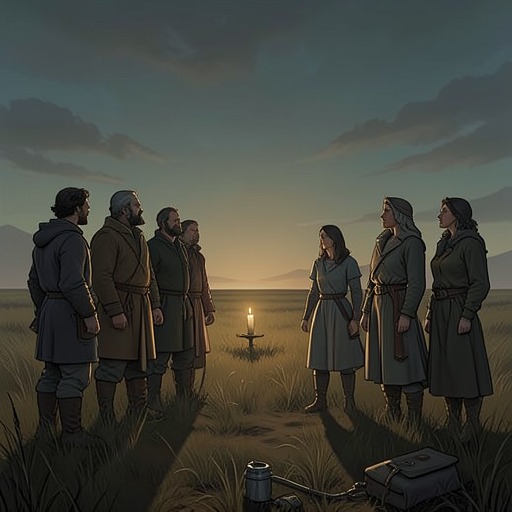
Hoid later appears to Kaladin Stormblessed in a radically different setting. Kaladin follows the sound of a low flute across the windswept rock of the Shattered Plains and finds a lone man at the tip of a peninsula surrounded on three sides by chasm. The man wears a lighteyes’s black uniform, has short black hair and an angular face, and carries the same kind of thin, black-sheathed sword associated with Hoid’s other appearances. A small fire made from rockbud shell burns before him.
The scene makes Hoid strange before he speaks. Kaladin has never heard of a lighteyed man playing a flute, since music is treated as a feminine pursuit for lighteyes men unless they are ardents. Hoid’s playing is exceptionally skilled, and its alien melody echoes through the chasm until it seems as though he is performing a duet with himself. The setting isolates him from the military order around the warcamps: he is neither participating in a battle nor simply observing one, but occupying a perilous threshold where sound, darkness, and distance loosen the ordinary categories of the world.
Hoid’s storytelling in this encounter also reveals a second register beneath his mockery. He recounts a tale in which a ruler, holding a blanket around herself and staring at her lands with haunted eyes, recognizes that an emperor long believed responsible for terrible murders has actually been dead for years. If the emperor is dead, she concludes, the crimes belong not to him but to those who committed them. Hoid’s story therefore turns on the collapse of an external excuse: political violence cannot be made innocent merely by assigning responsibility to a distant sovereign.
The change in Hoid’s manner is as important as the story’s moral claim. He stops taunting Kaladin and abandons the playful tone used earlier. The tale has come from within him, and Kaladin responds with silence before calling its conclusion cleverness. Hoid’s intelligence is thus not limited to verbal agility. His stories can carry guilt, historical memory, and the possibility that wit itself may be a way of approaching truths too painful to state directly.
Relationships and Narrative Function
Hoid’s encounters with Adolin, Dalinar, Elhokar, Sadeas, and Kaladin show that he operates across divisions that otherwise organize the narrative. He is familiar enough to Adolin to be greeted openly, bold enough to interrupt Sadeas, welcome enough at court to address Elhokar directly, and accessible enough on the Shattered Plains to meet Kaladin outside the structures of rank. These relationships are not equivalent friendships, but each gives Hoid a different function: court wit, political observer, provocateur, storyteller, and bearer of unsettling knowledge.
His relationship with Dalinar is especially revealing because Dalinar asks directly whether Wit is Hoid’s real name. Hoid answers by separating the adopted identity from the abandoned one, then gives Dalinar practical information before leaving. The exchange combines intimacy and refusal. Hoid calls Dalinar his friend, yet does not surrender the secret of his original name; he offers companionship without transparency. His apology for not insulting Dalinar more captures the same paradox, turning departure into another joke while acknowledging that the encounter has mattered.
Hoid’s relation to authority is therefore neither simple rebellion nor loyal service. He belongs near kings and highprinces, but his value comes from refusing to behave as their subordinate in the ordinary sense. He can speak where others must remain silent, yet what he says is often oblique. Rather than replacing political action, he introduces pressure into the conversation: a warning, an insult, a story, or a question that makes the existing order look less secure.
Change, Mystery, and Thematic Significance
Across his appearances, Hoid shifts from a visibly comic court presence to a solitary musician and morally serious storyteller, but the continuity lies in his control of distance. He is always near the decisive center of events without becoming fully absorbed into it. At court he arrives just before or just after violence, at the warcamps he moves between highprinces and soldiers, and on the Shattered Plains he stands at the edge of a chasm with a melody that seems to come from elsewhere.
His identity remains deliberately open. Hoid admits that his real name has been abandoned, but the admission supplies no stable biography. Instead, it makes naming itself part of his character: Wit is a role, Hoid is another designation, and both are presented as insufficiently final. The narrative uses this uncertainty to make him a living challenge to the assumption that a person’s visible title, eye color, uniform, or social function can explain who he is.
Near Kholinar, Hoid reacts to the revelation that the Almighty is dead. He asks the open night whether the world can feel that something has changed and describes the sound of that change in deliberately vulgar, comic terms. The guards at the city gates regard him with worry, listening to what they take to be a crazy man. Yet the scene places his apparent absurdity beside a genuine metaphysical rupture. Hoid’s laughter does not cancel the revelation; it becomes the form through which he registers it.
Hoid consequently serves as both trickster and threshold figure. His humor exposes vanity, his warnings anticipate danger, his music marks his separateness, and his stories convert distant history into immediate moral pressure. He does not provide a settled explanation of the wider world. Instead, he repeatedly demonstrates that every settled explanation—political, social, personal, or divine—may conceal another layer. His greatest narrative power comes from making uncertainty active: not ignorance that stops inquiry, but strangeness that sends the characters and the reader looking beyond the scene in front of them.